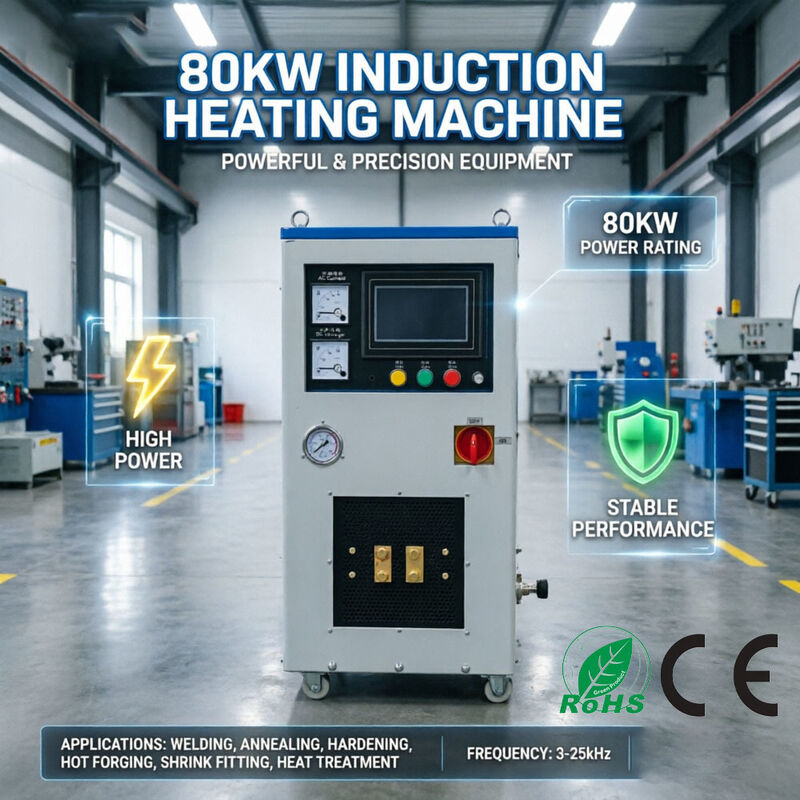
| Brand Name: | OURUIDA |
| Model Number: | SF-80KW |
| MOQ: | 1set |
| Price: | USD1500-3500 |
| Packaging Details: | PLY WOODEN BOX PACKAGE |
| Payment Terms: | L/C,D/A,D/P,T/T |
Induction heating is a fast, efficient, precise, repeatable, and non-contact method for heating metals or other electrically conductive materials. An induction heating system includes an induction power supply that converts line power to an alternating current, delivers it to a workhead and work coil, and creates an electromagnetic field within the coil. The workpiece is placed inside the coil, where this field induces a current in the workpiece, generating heat directly within it.
Annealing of metal tubes, such as inner-hole annealing of stainless steel and copper tubes, to eliminate processing stress and improve ductility. Applied in air conditioning pipelines and automotive oil pipes.
Precision parts processing: bearings and gears, electronic components.
Tool and mold repair.
Automobile components: connecting rods and crankshafts.
Gear blanks, steel bars, rods, and tubes; preheating for fastener thread rolling.
Tool and mold manufacturing: tool forging and mold repair.
Electricity and energy industry: heating of transmission tower bolts and connection of copper-aluminum conductors.
Automobile parts manufacturing: gears and shafts, steel rods and bars, bearings, and crankshaft strengthening.
Tool and mold processing: tool hardening and strengthening of milling cutter and drill bit cutting edges; mold reconditioning.
Energy and heavy industry: oil pipeline flanges and mining machinery wear-resistant parts.
Hard brazing, tin soldering, tool brazing, and aluminum brazing.
This methodology is extensively deployed across diverse manufacturing applications, including but not limited to the automotive, aerospace, toolmaking, and heavy equipment industries.
This high-strength joining technique is broadly adopted in precision manufacturing and maintenance for critical couplings, including gears, rotors, bearings, and complex housings.
Melts metals such as steel, copper, and aluminum for casting.
Heat-seals food containers and beverage bottles using induction.
Induction heating achieves up to 90% energy conversion efficiency, compared to less than 60% for conventional gas or resistance heating. Since heat is generated directly inside the workpiece, there is minimal energy waste heating the surrounding air. This is a major selling point for factories facing rising electricity costs and carbon-reduction targets.
Induction heats metal in seconds rather than minutes or hours. This dramatically shortens cycle times and boosts throughput, allowing manufacturers to produce more parts per shift.
The heating zone is highly localized and can be controlled with tight accuracy (e.g., ±5°C). This ensures consistent product quality, minimizes material distortion, and reduces scrap rates — critical for automotive, aerospace, and precision machining buyers.
No open flame, no combustion gases, no smoke or fumes. Only the workpiece gets hot, while the coil remains cool. This creates a safer workplace and helps factories comply with strict environmental regulations in Europe and North America.
Induction systems integrate seamlessly into automated production lines and can be equipped with IoT-enabled controls for remote monitoring, data logging, and predictive maintenance — a strong trend in smart manufacturing.
Although the initial investment is higher than traditional methods, buyers typically see a return on investment within 1–2 years through energy savings, reduced labor, lower maintenance, and less material waste.
Induction heating serves a wide range of applications: metal hardening, brazing, welding preheat, shrink fitting, forging, annealing, melting, and coating removal. This broad applicability makes it attractive to diverse international customers.